Articles
David writes about language, writing, storytelling, and the practical skills behind clear communication. Here you’ll find articles on plain English, business writing, and the craft of making words work in harmony.
Whether you’re looking to improve your own writing, avoid common communication pitfalls, or simply enjoy David’s take on language and storytelling, new articles will be added regularly.
Filter by category

If thought leadership lacks original thought, it’s just contrived content
Although the phrase itself is only a few decades old, thought leadership has been around for millennia. There’s the Bible, for example. But when Joel Kurtzman coined the phrase in 1994, it was from the perspective of business leadership – he being the founding editor-in-chief of Strategy+Business magazine.
He defined a thought leader as an industry expert who shares their expertise for the purpose of educating, improving, and adding value to the industry as a whole. Others assert that the true value of thought leadership lies in providing trustworthy insights and perspectives gained from the thought leader’s expertise and experience.
Thought leadership, then, has tremendous value. After all, who doesn’t want to be guided by renowned experts – to gain knowledge and to make better, and better-informed, decisions?
But with great power comes great responsibility.
The responsibility to be honest, truthful, accurate, and (surely) if the piece is published in your name, for the words to be yours. You – the expert.
The problem is, they often aren’t.
Of course, thought leaders are not necessarily great writers. Turning to a copywriter to edit and hone a piece for readability seems perfectly reasonable. It’s just polish. But if someone other than the named author actually writes the words, and the ‘expert’ simply rubber-stamps the piece, that’s a different matter. At best it’s just lazy, and at worst it’s probably a disingenuous attempt to disguise content as genuine thought leadership.
Worse still, much of what gets passed off as thought leadership is actually produced by AI. This is where the waters get really murky. People read it because, according to the attribution, it’s been written by a leading expert in their field. We want and value that person’s insights. We want to benefit from that person’s unique experience and expertise. But if those thoughts and insights are instead just a mush of generalisations and other people’s ideas, judged by AI as relevant, how should we feel about that…?
Someone posted the following on Linked-In recently, and it had me nodding in approval: “If you can’t be bothered to write it, why should I bother to read it?”
But I think it goes deeper than that. Surely ‘thought leadership’ that’s attributed to an expert who didn’t actually write it has little or no value, and that expert (or the organisation they represent) does not deserve their readers’ trust and respect.
Many online and offline publications obviously agree. Responding to the sheer volume of AI slop making it onto their pages, a large number of them – including national newspapers, consumer magazines, and industry publications – have banned AI-written content. Some are even slapping long-term publishing bans on contributors who break the rules. LinkedIn, too, has responded to the abundance of slop by giving readers the power to call it out.
Vive la révolution, I say!
Don’t get me wrong: I’ve grown to like AI. I find it incredibly useful for all sorts of background tasks. But returning to Joel Kurtzman’s definition of thought leadership, AI is not an industry expert – a thought leader – and to substitute it for one is to devalue the concept. AI provides production-line content, not unique perspectives that reflect authentic personal experience and expertise.
LinkedIn is a natural medium for the keen insights of industry leaders and experts, and their thought leadership is as valuable today as it has always been. I’m grateful to those who take the time and effort to share theirs.
As long as it’s the genuine article.
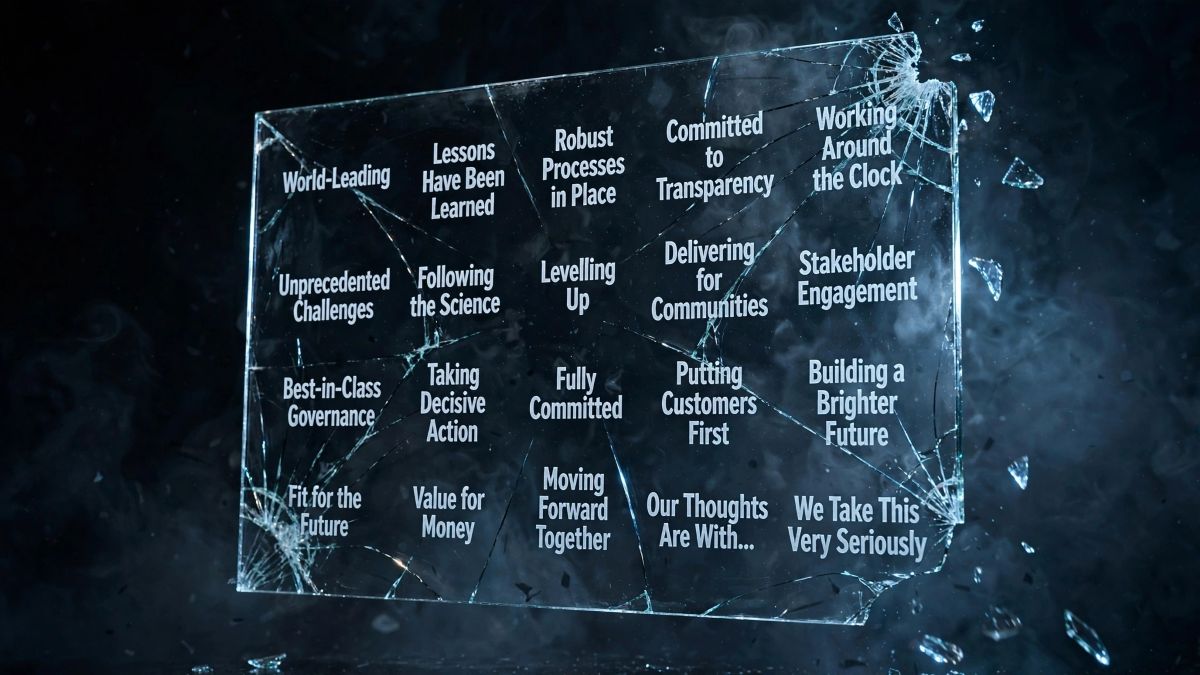
Is your PR trusted, or dismissed as AI slop?
(and how to use AI to help create pretty darned good PR!)
How often have you read a press release and thought: what a load of [expletive]!
Think of the health authority reassuring us of their commitment to reducing A&E waiting times, or the transport minister justifying yet another rise in train fares (despite continual delays and overcrowding), or the water company trying to convince us that they are actually performing really rather well…
Away from the national press, every sector publication features a regular tranche of press releases – congratulating, announcing, stroking, reassuring, and occasionally apologising.
Some hit the mark. They feel sincere: the empathy real; the reassurances believable; the tone genuine; the quotes genuinely personal. They connect with you.
But most do not. They ooze insincerity, or feel superficial and formulaic: clunky phrasing; trite platitudes; evasive or meaningless waffle; a slop of corporate gobbledygook. No soul. Artificial.
Of course, that’s not all down to AI. These days, an awful lot of PR and marketing copy is produced not by professional copywriters but by a new breed of hybrids, with limited skills and no craft. Some are simply unaware of how to write in a way that will connect with their audience, and others compensate with an overreliance on AI but lack the skills to edit and hone its output.
Yet, as far as press releases are concerned, it’s not actually difficult (with some effective prompting) to extract a half-decent one from AI.
As a benchmark, let’s start by replicating a typical ‘corporate waffle’ press release. You will undoubtedly recognise the result because it will be very similar to many of the press releases you’ve read during the last few years…
- Open any AI text generator.
- Copy and paste the following prompt into its ‘create’ field, and behold!
Write a 400-word press release from Londonshire Health Authority, filled with typical corporate-style words and phrases, to provide assurances that the current high A&E waiting times will be reduced.
As I’m sure you will agree, the result is utterly cringeworthy. True, we forced AI to create this guff for the experiment, but it is undeniably similar to what many organisations seem to think will connect with their audience. And you can see just how universal this generic type of PR is by adjusting the prompt for your own sector, and regenerating.
In fact, try having some fun with it to brighten your day! Get creative – a favourite of mine is: Write a harsh and combative 400-word press release from Darth Vadar, filled with typical corporate-style words and phrases, to provide assurances that the current rebellion will be crushed.
Some AI text generators will even let you include rude words, which produces an interesting twist to the result!
Anyway, let’s get serious again. Now that you’ve got your benchmark, let’s improve on it.
- Repeat, this time adding a tone and specific details to the prompt.
- Write a brief list of favourable words to include.
- Add a negative prompt (what you don’t want AI to include).
- Specify the requirement for a quotation.
For example:
Write a sincere and empathetic 400-word press release in plain English from Londonshire Health Authority, to provide assurances that the current high A&E waiting times will be reduced, emphasising that A&E staffing resources have been increased by 16% during the first quarter of this year and that positive results are being seen from proactive triaging by nursing staff, to include some of the following words and phrases: at the heart of, benefit, caring, challenges, experience, genuine, helpful, important, major, one team, people of Londonshire, we will not rest until. Also include a positive quotation from Anne Smeeton, Regional Health Director. Negative (do not use): corporate-style words and phrases.
[A pause while you generate it.]
Yes, the result would definitely benefit from some adjustments to help it really connect with people on a personal level. And that’s why good writing skills are still an important asset in the workplace. AI doesn’t possess empathy, it can only approximate it – yet empathy is the most important element of effective PR: one soul connecting with another, communicating genuine sincerity.
Still, I’m sure you’ll agree that it’s a pretty good starting point.
People deserve honest, clear, and concise messaging; written in plain English and free of confusing abstractions and ambiguities. Organisations that peddle nonsensical gobbledygook in their PR and other media really need to embrace this, because writing clear, direct, easy-to-understand communications is the path to connecting with their audience, and earning their respect and trust.
For a comprehensive guide to producing better business communications, check out The Rude Guide To Being A Better Writer. With clear explanations and relatable examples throughout, the book shows you how to use plain English to write effective business communications that are clear, concise, easy to understand, and error free. Written for a modern audience, the book uses storytelling and adult humour to deliver a learning experience that is as entertaining as it is rewarding.